 Community Animal HospitalsGuided by AAHA standards · St. Petersburg, FL
A veterinary orthopedic surgeon operates in our own surgical suite. Your pet has the procedure at Community Animal Hospitals, is recovered by a team that knows the practice, and in most cases goes home the same day. Before any work begins you receive a written, itemized estimate for all proposed diagnostics and treatment.
Tell us what your veterinarian has told you and we’ll get back to you with the next step.
For dogs and cats.
The most common orthopedic problem in dogs. Owners usually describe it as a torn knee, a torn ACL, or “she tore something.” In dogs the ligament is the cranial cruciate — CCL — and there is more than one way to repair it. A TPLO changes the angle of the top of the shin bone so the joint no longer depends on the ligament. A lateral suture stabilises the joint from the outside. Which one suits your dog depends on their size, age and how active they are — the surgeon decides that after reviewing the x-rays. Either can be done on one knee or both.
A kneecap that slips out of its groove, in one knee or both. Where the groove itself is too shallow it is deepened — trochlear regrooving — as part of the repair.
For a hip that is painful and not repairable, the head of the femur is removed and the joint rebuilds itself in soft tissue.
Broken legs, plated or pinned. Jaw fractures, which need their own approach. And pelvic injuries — including a sacroiliac luxation, the separation that often follows a road accident.
The fragments that cause it — OCD, FCP, UAP — and, where the shape of the bone is the problem, a corrective ulnar ostectomy.
Limb amputation and single-digit amputation, both done here at Community Animal Hospitals.
Plates, pins or screws that are causing a problem — whether they were placed here or elsewhere.
This is only a partial list — we perform most orthopedic procedures for pets. If your veterinarian has named something that is not here, ask. The answer is more often yes than no.
Not done here: total hip replacement. If that is what your pet needs, we will tell you, and tell you where to go.
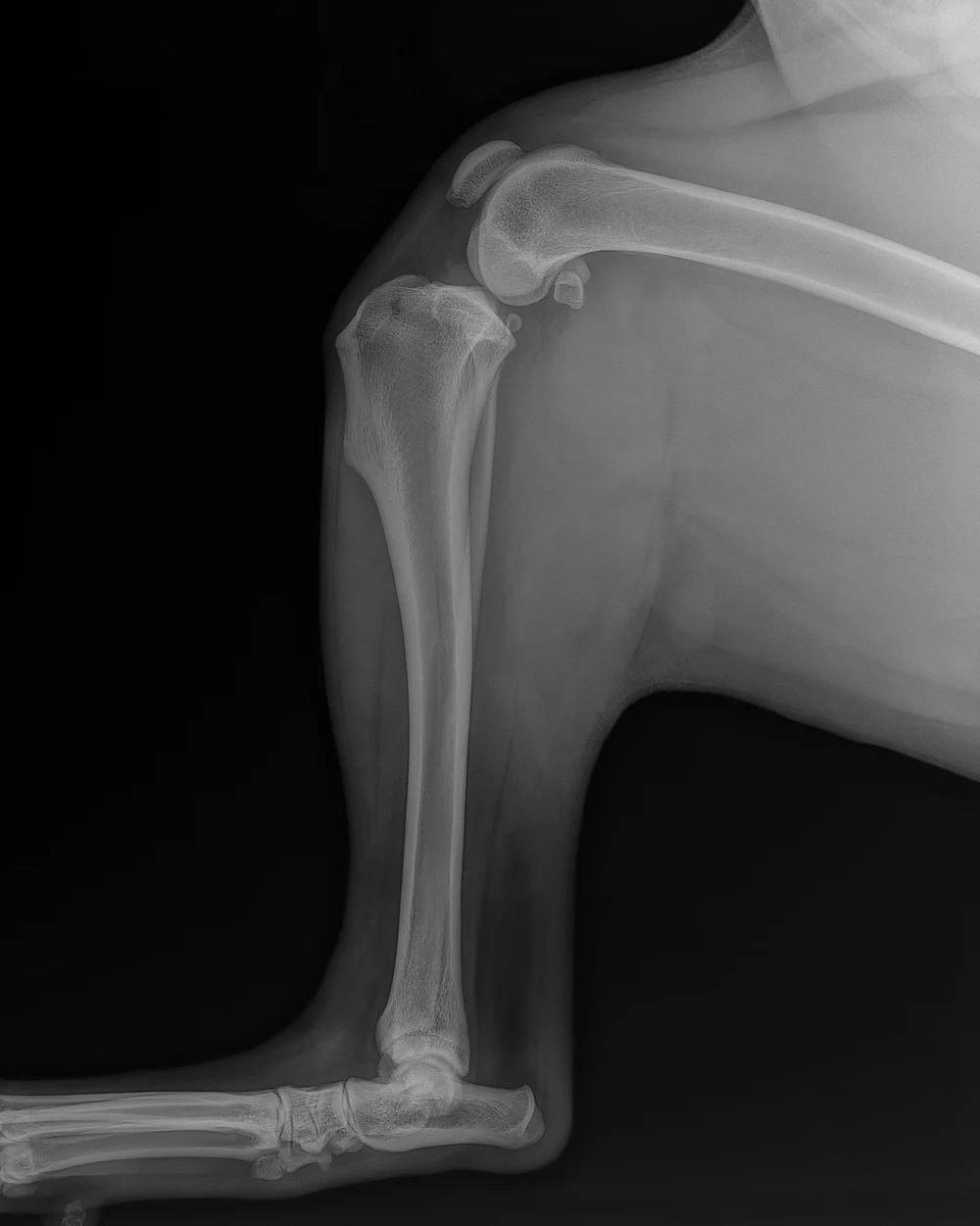
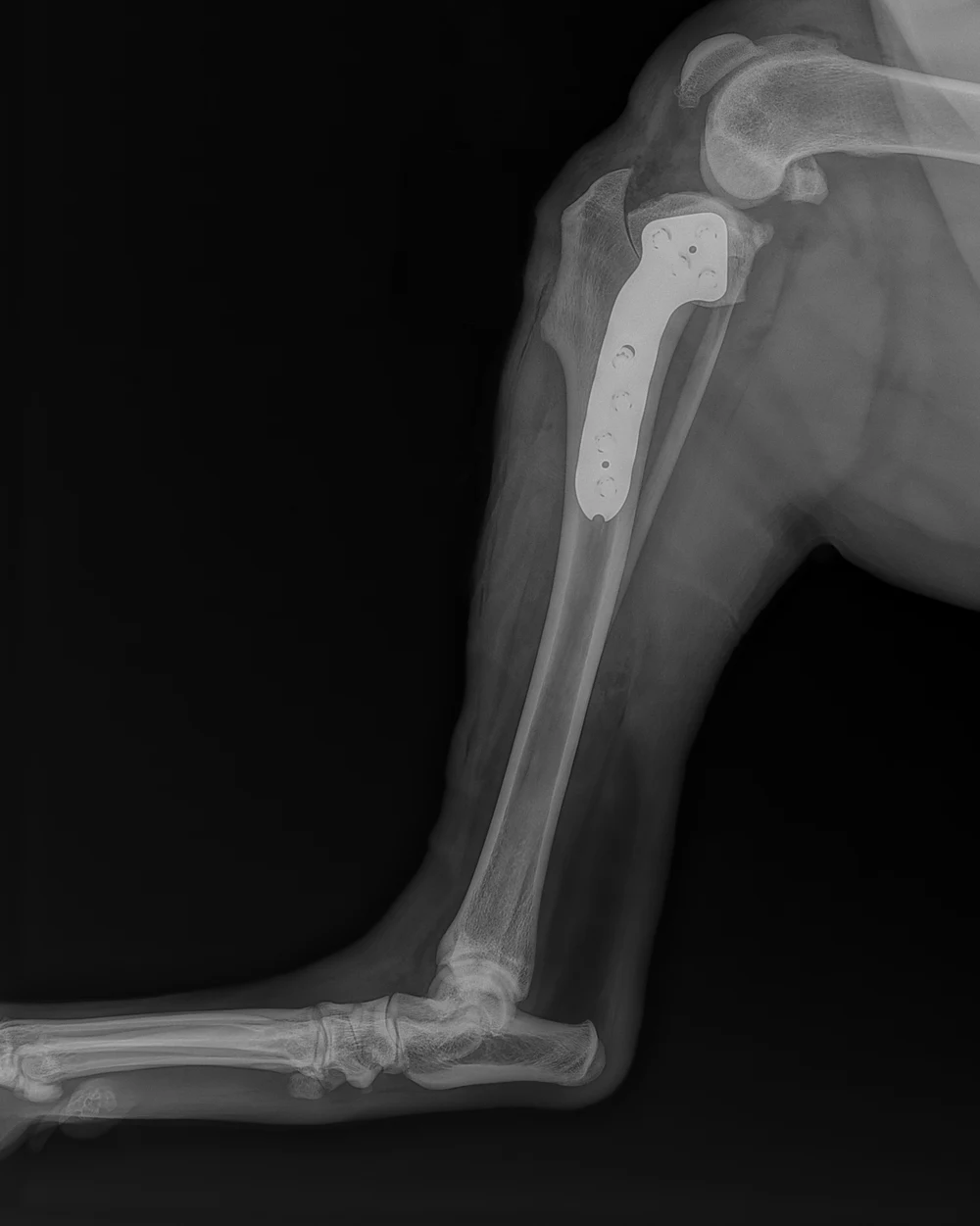
A real patient treated at one of our hospitals. Identifying details have been removed.
A one-year-old cat weighing 4.8 pounds. Both bones of the forearm were broken near the wrist.
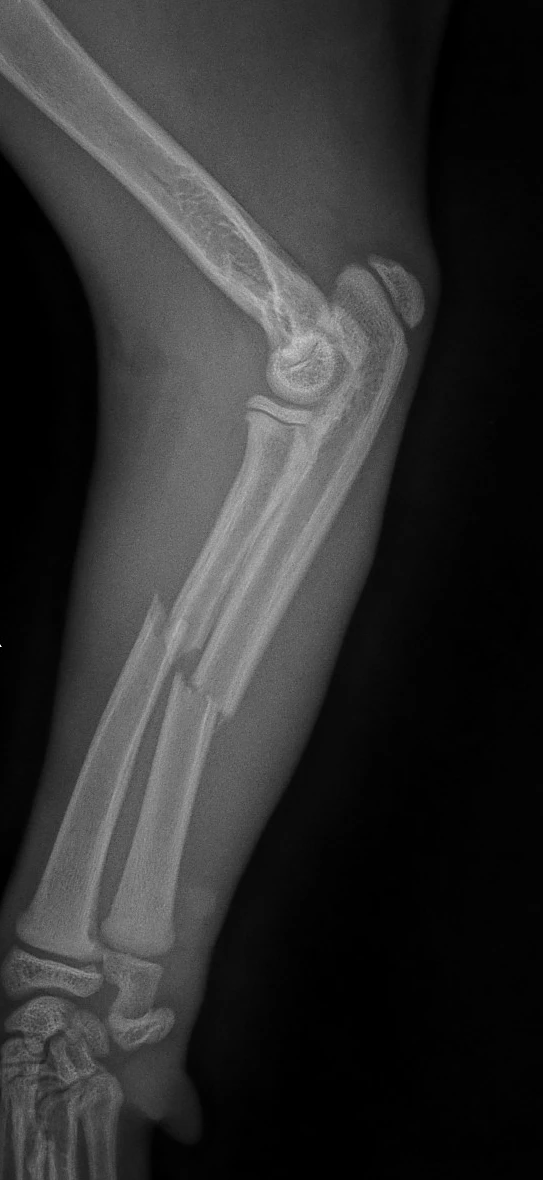
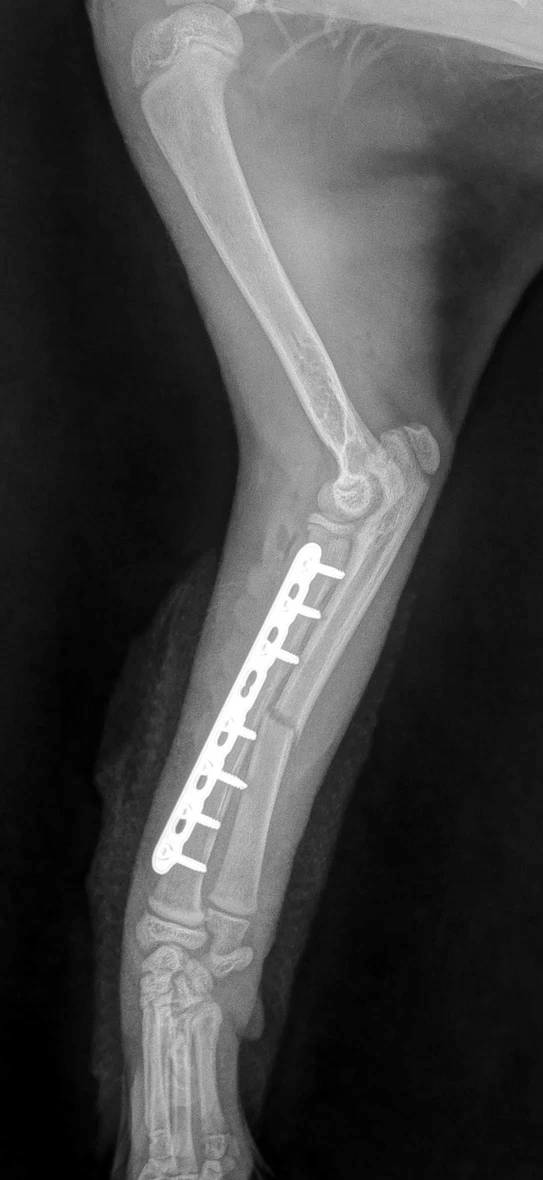
A real patient treated at one of our hospitals. Identifying details have been removed.
A veterinary orthopedic surgeon comes to Community Animal Hospitals and operates in our surgical suite. They bring their own instruments and their own assisting staff. Our team handles your pet before and after — the same people you would see for anything else.
Questions specific to the orthopedic surgery are answered by the orthopedic surgeon. They usually come through one of our own doctors first, who knows your pet’s history and brings the surgeon in on anything orthopedic.
We do not provide overnight care. For most procedures your pet goes home the same day — home is quieter, and you are the person who notices first when something is not right. You will go home with written aftercare instructions and a number to call if anything worries you.
If your pet does need overnight monitoring, we will say so and refer you to a 24-hour facility that can give it. That is a judgment made on the day, about your pet — not a policy.
After you get home, you call us — six days a week, 7:30am–6:30pm. Not an answering service that has never met your pet.
Because there is no single number, and quoting one would be a guess. A TPLO that takes forty-five minutes and one that takes ninety are different operations to run — anesthesia and monitoring are still going the whole time. What a fracture needs is not fully known until it is imaged and, sometimes, until it is open.
You receive a written, itemized estimate for all proposed diagnostics and treatment before any work begins. Nothing is scheduled until you have seen it and said yes.
Most people reach us having been told their pet needs surgery, with no x-rays yet. So the first step is usually imaging. We take the films here, on our own digital x-ray equipment. The orthopedic surgeon reviews them, and we come back to you with a written estimate and a surgery date.
Many diagnostic x-rays can be taken with your pet awake. A pet that is very painful or anxious may need sedation to be positioned safely. Either way, you receive an estimate for all proposed diagnostics and treatment before any work begins.
If your own veterinarian has already taken x-rays, we can work from those — send them, or tell us who has them and we will request them for you.
The surgeon usually does not need to examine your pet separately. Occasionally they do. If that applies we will tell you, and we will tell you what that visit costs before anything is booked.
Many of our clients find that financing part or all of the procedure through Cherry works best for them.
According to Cherry, the application takes under 35 seconds from start to finish, and “Cherry performs a soft credit check which does not affect your credit score.”
Check your options with Cherry
We also accept CareCredit and Scratch Pay.
Almost never, and age by itself is not the reason to decline. In the largest study of US primary-care practice — 822 hospitals — the anesthetic death rate was 0.05% in dogs and 0.11% in cats. What moves that number is health status, not age: in sick patients it rises roughly twenty-five fold. Which is why what we do before the procedure matters more than the number on the birthday.
Bloodwork, a physical examination, and a plan built around what we find. If something turns up that changes the risk, we tell you before the day, not after.
AAHA’s 2023 senior care guidelines: “Advanced age alone is not a contraindication to general anesthesia.”
Orthopedic surgery is scheduled around the surgeon’s availability, and dates fill. The sooner we have your pet’s records and imaging, the sooner we can give you a date.
You do not need a referral. If your veterinarian has already taken x-rays, ask them to send the images and the notes to Community Animal Hospitals — or tell us who they are on the form above and we will request them for you.
5895 54th Ave N, St. Petersburg, FL 33709
Clients travel as far as 15–20 miles for surgery with us, from St. Petersburg · Gulfport · Pinellas Park · Seminole · Bardmoor · Tyrone Square · South Pasadena · Kenneth City · Lealman and beyond · Open 7:30am–6:30pm, six days a week
Yes. A veterinary orthopedic surgeon operates at Community Animal Hospitals, in our own surgical suite, and our team looks after your pet before and after. You do not need a referral letter. Send us what your veterinarian told you and any x-rays they have taken, and we will tell you what we can do.
Most dogs put weight on the leg within a few days and are back to normal activity in a few months. In between, activity is restricted — lead walks only at first, no stairs and no jumping, then a gradual return. The restriction is the part owners underestimate, and it is what protects the repair while the bone heals.
Often, eventually. Whatever predisposed the first knee usually applies to the second, so a dog that tears one cranial cruciate has a real chance of tearing the other. It is worth knowing at the start rather than being surprised by it a year later. Both knees can be repaired, and we will tell you if we think the second one is coming.
We do not provide overnight care. For most procedures your pet goes home the same day. If your pet does need overnight monitoring, we will say so and refer you to a 24-hour facility that can give it — a judgment made on the day, about your pet.
Yes, for a TPLO and for most fracture repairs. The plate and screws are not routinely removed. If hardware does cause a problem later, taking it out is a smaller procedure than putting it in.
Usually yes, and weight is part of the conversation because it changes both the surgery and the recovery. Extra weight loads a repaired joint, and it loads the other three legs while your pet is favouring one. If there is time before surgery, losing some is one of the few things you can do yourself that helps the outcome.